
 English
 中文简体
中文简体 Home / News / Industry News / Can a Baby Sleep in a Car Seat Overnight? Safety Limits, Risks, and Fixes
Industry News
Can a Baby Sleep in a Car Seat Overnight? Safety Limits, Risks, and Fixes
2026-10-02
Content
- 1 The Short Answer: Minutes Are Fine, a Whole Night Is Not
- 2 Why a Car Seat Cannot Stand In for a Cot
- 3 What Happens to a Baby's Airway in a Reclined Seat
- 4 Time Limits by Age: A Practical Rule Set
- 5 Parked in the Driveway Is Often Riskier Than the Motorway
- 6 Six Checks That Keep a Napping Baby Breathing Freely
- 7 Heat, Layers, and the Five-Minute Trap
- 8 Moving a Sleeping Baby Out of the Seat
- 9 What a Safe Night Looks Like at Your Destination
- 10 Long Journeys: A Plan That Survives Real Life
- 11 Shopping for a Seat With Long Trips in Mind
- 12 Older Children: The Danger Changes Shape
- 13 How These Questions Shape What Gets Built and Tested
- 14 Frequently Asked Questions
- 14.1 Can a baby sleep in a car seat overnight if the car keeps moving and an adult stays awake?
- 14.2 Is it safer if my seat reclines almost flat?
- 14.3 My baby will only fall asleep in the car seat. What do I do at night?
- 14.4 How long can a newborn stay in a car seat in one go?
- 14.5 Can my baby nap in the car seat inside the house?
- 14.6 Do i-Size seats make overnight sleep safe?
- 14.7 At what age does overnight sleep in a seat become acceptable?
- 14.8 What about a night ferry or a long flight?
It is 21:40, the rain is hammering the windscreen, and your ten-week-old has finally stopped crying and gone quiet in the infant seat behind you. You are still two hours from the hotel, and the easiest thing in the world would be to let her sleep exactly where she is until morning. Almost every parent reaches this moment on a long trip, and almost every parent quietly asks the same question: can a baby sleep in a car seat overnight?
The answer from paediatric sleep and injury-prevention teams is no. A car seat is a crash-protection device that a baby happens to find comfortable, not a bed, and it is not tested as one. What follows is the practical version of that answer: where the real danger sits, how long is genuinely acceptable at each age, the checks that keep a sleeping baby's airway open, and what to do instead when you pull up at the hotel with a baby who is deeply asleep.
The Short Answer: Minutes Are Fine, a Whole Night Is Not
A fifteen-minute nap in a correctly installed seat while you drive is normal and low risk. A baby going back to sleep in that same seat after you arrive - staying strapped in for five, six or eight hours in a parked car or a hotel room - is a different activity with a different risk profile, and no car seat on the market is designed, tested or approved for it.
The two situations can look identical. The baby is asleep either way. What changes is how long the body spends curled at an angle, and whether an adult is close enough to notice something going wrong.
Built for impact, not for sleep
Every seat sold under ECE R44 or ECE R129 passes dynamic sled tests that simulate a frontal crash. Not one of those tests involves an infant sleeping for six hours on a stationary floor.
Why two hours keeps coming up
Health services across the UK, Australia and much of Europe advise taking a baby out of a car seat every two hours at most, and much sooner for newborns. That number comes from paediatric research, not from the seat's certification.
What good actually looks like
A monitored nap of one to two hours while the car is moving, a proper break afterwards, and a flat, firm surface for the night. The seat does the driving; the cot does the sleeping.
If your only experience of the question so far is a forum thread where someone said their doctor approved an overnight stay in the seat, treat that as one person's recollection rather than a standard. The written guidance is consistent, and it is not written to be cautious for its own sake.
Why a Car Seat Cannot Stand In for a Cot
Start with the geometry. A cot mattress is flat, and a baby lying flat needs almost no muscular effort to keep an airway open. A car seat holds a baby at roughly 40 to 45 degrees from horizontal, curled inside a bucket-shaped shell with a harness pulling the shoulders back. That shape is excellent at spreading crash forces and stopping a small body from being thrown forward. It is a compromise when it comes to breathing, and the compromise grows with every hour.
The shell holds the head where the harness wants it
When a baby drops into deep sleep, muscle tone falls. In a bucket seat, that loss of tone lets the head drift forward until the chin approaches the chest, or sideways until the neck twists. In a flat cot the same loss of tone simply leaves the head resting on the mattress. This is why the caution around car seats is not about comfort - it is about the position of the head relative to the windpipe.
Safe sleep surfaces are boring on purpose
Cots are firm, flat and free of soft padding. Car seat shells are the opposite: contoured, cushioned and lined with fabric that traps warmth. For a twenty-minute nap that is pleasant. Over several hours it means a hot baby in a position they cannot adjust, because they cannot roll, push up or turn their head freely while strapped in.
Overnight removes the supervision that makes naps acceptable
The one advantage a moving car gives a sleeping baby is an adult who can glance in the mirror, pull over, or reach back at a red light. Overnight, when one parent is driving dark motorway miles and the other is asleep, that supervision disappears. This is the most common blind spot in the whole discussion: the danger is not only the seat, it is the seat with nobody watching it.
What Happens to a Baby's Airway in a Reclined Seat
A newborn's head accounts for roughly a quarter of total body weight, and the neck muscles that control it are still developing through the first four to six months. Put that head against a soft, angled cushion and gravity wins. The chin drops, the soft tissue at the back of the throat bunches up, and the airway - only a few millimetres wide in a young infant and soft rather than rigid - narrows.
Positional asphyxia does not announce itself
This is the part that surprises parents most. A baby whose airway is becoming restricted usually does not cough, gasp or thrash. They go quiet and still, which from the front seat looks exactly like deep sleep. Injury-prevention teams call this positional asphyxia, and it is the reason a sleeping baby in a car seat should never be left unobserved for long stretches.
What monitoring studies recorded
Research groups have measured oxygen saturation in infants sleeping in car seats and compared it with the same babies sleeping flat. A share of the babies showed lower oxygen levels and brief pauses in breathing while seated, and the effect was strongest in babies born prematurely, babies with low birth weight, and babies with low muscle tone or significant reflux. Not every baby is equally vulnerable, but you cannot tell from the outside which group your baby belongs to.
"She looks comfortable" is not evidence
Comfort is not a safety measurement. A baby whose chin has dropped toward the chest and whose head has rolled to one side can look peaceful while struggling. The only reliable check is visual and immediate: can you see the whole face, is the chin clear of the chest, is the head sitting square rather than slumped?
Time Limits by Age: A Practical Rule Set
No regulation sets a maximum time in a car seat, because approval is about crash performance. The limits below come from health-service guidance and everyday paediatric practice. All of them assume a supervised, correctly installed seat, and none of them turns a seat into a bed for the night.
| Age band | Continuous time in the seat | Why the limit sits there |
|---|---|---|
| Newborn to 4 weeks | 30 to 45 minutes per stretch | Head control is minimal and the airway is at its narrowest; the same reason hospitals watch newborn breathing closely |
| 1 to 4 months | Around 60 minutes, then a break | Head control is improving but not dependable once the baby is deeply asleep |
| 4 to 9 months | Up to 90 minutes, then a break | The baby holds the head up when awake but still slumps heavily during sleep |
| 9 to 15 months | Up to 2 hours | Most health services cap any age at two hours; i-Size seats still require rear-facing travel at this age |
| 15 months to 4 years | 2 hours, then a break and a stretch | Posture, circulation and comfort matter more than the airway from this point |
| 4 years and older | 2 to 3 hours | Neck fatigue, numb legs and travel sickness; boosters barely recline at all |
It helps to see how ordinary journeys compare with the two-hour line. Most daily driving is nowhere near the limit. It is the holiday leg, the funeral trip and the airport run at 4 am where families quietly overshoot.
Quick errands 10 min
Nursery run 25 min
Day out 90 min
Holiday drive 5 hours
Overnight run 8 hours
The bars in the darker tone mark journeys that go well past the two-hour guidance. Those are the trips that need planning before they happen, not adjusting once the baby is asleep in the back.
Parked in the Driveway Is Often Riskier Than the Motorway
Parents usually assume the danger lives in traffic. In practice, a large share of car seat injuries happen when the vehicle is standing still - an infant seat on a kitchen worktop while the kettle boils, a seat balanced on a sofa while a toddler runs past, a carrier resting on a soft bed with an exhausted parent beside it.
Three reasons the stationary scenario is worse than people expect:
- Soft surfaces change the angle. A seat placed on a mattress or cushion can settle or tip, and the recline you carefully checked in the car is no longer the recline the baby is sleeping in.
- Motion keeps you aware; stillness does not. In a moving car every bump reminds you the baby is there. In a living room, the seat quietly becomes furniture, and twenty minutes becomes ninety without anyone deciding it should.
- Heat builds without noise. A parked car in summer can reach temperatures far above ambient within twenty minutes, and a baby in a padded shell under a blanket cannot shed that heat effectively.
If you must bring the seat indoors, put it on the floor, in plain sight, and lift the baby out as soon as you are finished. Never balance an infant seat on a raised surface, and never leave a sleeping baby strapped in while you work through the rest of your evening.
Six Checks That Keep a Napping Baby Breathing Freely
These are the checks that matter most on a journey where a nap is going to happen anyway.
- Match the recline to the seat's own indicator. Most infant seats carry an angle gauge or level line. Too upright pushes the head forward; too flat can compromise how the harness holds the baby in a crash.
- Confirm the installation is tight. At the belt path or the ISOFIX connectors, the seat should move less than about 2.5 cm when you push and pull it firmly.
- Fit the harness to the body, not to clothing. Two fingers should slide under the strap at the collarbone, no more. The chest clip sits at armpit level.
- Lose the bulky coat. Thick jackets create a gap between the harness and the body. Dress the baby in a thin layer and put the blanket over the harness, never underneath it.
- Stay rear-facing as long as the seat allows. Under ECE R129 children must travel rear-facing until at least 15 months, and most injury-prevention specialists recommend going well beyond that.
- Watch the head. A mirror or a passenger in the back row lets you see whether the head has slumped forward. If it has, stop at the next safe place and reposition.
One buying detail is worth knowing before you own the problem: an adjustable recline combined with a support leg or top tether makes it far easier to hold a correct angle in a real car, on a real bench, with a real child in the seat. Seats such as our ISOFIX 360-degree rotation model with a support leg and a 40-105 cm height range are engineered around that adjustability, because the angle the seat actually holds is what protects a sleeping baby's airway. For a fuller walkthrough of fitting tolerances and common installation errors, our guide to choosing a baby car seat is worth reading before your next long trip.
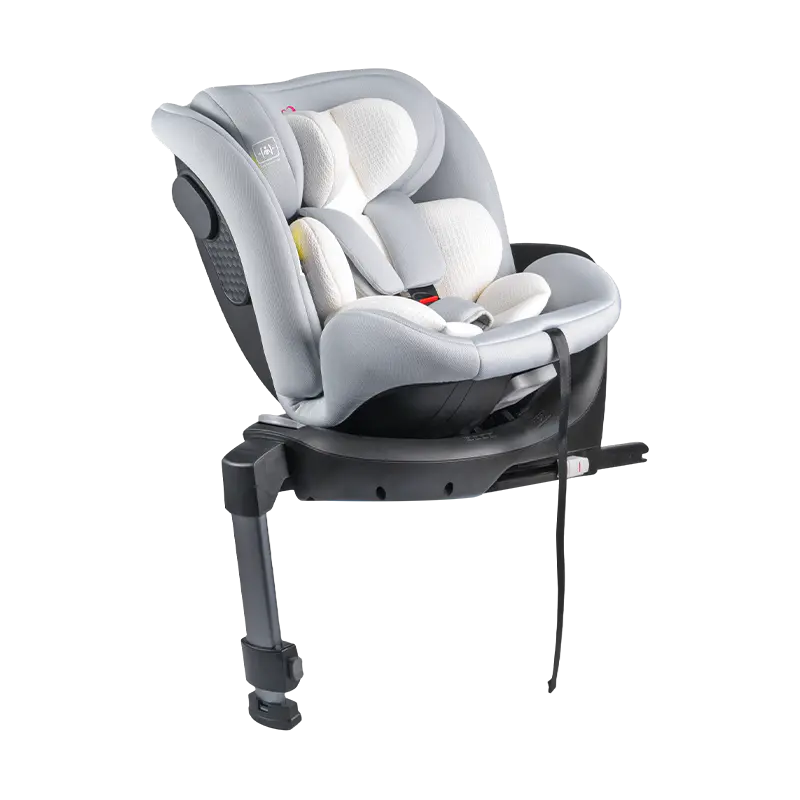 HB326 ISOFIX + support leg 360 Rotation Rearward/Forward facing baby car seat 40-150cmThe HB326 ISOFIX + support leg 360 Rotation Rearward/Forward facing baby car seat 40-150cm is equipped with ISOFIX interfaces and support legs, providing stable fixing...View Product →
Heat, Layers, and the Five-Minute Trap
Overheating is the quiet second risk of long spells in a seat, and it is easy to create by accident. A padded shell, a synthetic cover, a hat and a blanket add up quickly in a warm car, and a baby strapped into a harness cannot kick off a layer or roll away from a hot surface.
- Dress the baby for the temperature inside the car, not the temperature outside it. Remove hats indoors and in warm vehicles.
- Cool the car before strapping in. Running the air conditioning for two minutes takes less time than peeling off a sweaty cardigan later.
- Check the back of the neck and the chest, not the hands, for signs of overheating.
- Never leave a baby in a parked car, even with the windows partly down and even for two minutes.
The five-minute trap is the habit of leaving a sleeping baby in the seat while you unload shopping, check into a hotel or settle an older child. Those five minutes stretch, the neck accumulates more time in the same position, and supervision drops to nothing. Set a phone alarm the moment you park. It sounds excessive, and it works.
Moving a Sleeping Baby Out of the Seat
If the plan for the night is a proper bed, the transfer is the moment that decides whether the evening goes smoothly. A baby woken abruptly at 11 pm can take an hour to resettle; a baby moved carefully often does not wake at all.
- Park, switch off the engine, and keep the cabin quiet and warm.
- Recline the seat to its flattest available position before you touch the harness.
- Loosen the harness straps first. Lifting a baby out of a tight harness drags at the shoulders and shifts the seat.
- Support the head and the base of the neck with both hands, and lift the baby straight up rather than sideways.
- Have the destination ready before you begin: a travel cot already assembled beside the car, or a pram carrycot waiting at the door.
- Keep the lights low and do not re-dress the baby. Straight onto a flat mattress, on the back, is the goal.
For newborns who fall asleep in an infant carrier, the handle design matters more than most parents expect. A wide, well-balanced handle and a shell you can set down flat mean you are not juggling a sleeping baby and a tipping seat at the same time. That thinking sits behind our aluminium-handle infant carrier, built so the seat can be set down and lifted with one hand while the other supports the baby's head.
 HB801AL Aluminum handle infant baby carrier car seat Group 0+HB801AL Aluminum handle infant baby carrier car seat Group 0+ is designed for infants and toddlers weighing up to 13 kg, suitable for ages from birth to approximately ...View Product →
What a Safe Night Looks Like at Your Destination
Once you arrive, the car seat's job is over. A safe overnight sleep surface has four features: it is firm, it is flat, it is free of soft bedding, and the baby lies on their back in the same room as an adult.
- A crib, cot or travel cot that meets a recognised standard, with a mattress that fits without gaps at the sides.
- A fitted sheet only. No pillows, no quilts, no bumpers, no soft toys inside the sleep space.
- A room that feels comfortable to a lightly dressed adult, generally somewhere around 16 to 20 degrees Celsius.
- The baby in the same room as you for the first six months, but on a separate surface.
Two things go wrong most often on the first night away from home. The first is using the car seat as a makeshift cot because the cot is still in the boot. The second is bed-sharing after a long, exhausting drive, particularly if either adult has taken medication, been drinking, or is so tired they cannot be sure they will wake. Both are understandable, and both are far easier to plan around before the trip than at midnight.
If the baby falls asleep in the seat ten minutes from the hotel, wake them gently and transfer. Babies tolerate a transfer much better at that stage than they do an hour later, once they have settled into a deeper sleep in the wrong position.
Long Journeys: A Plan That Survives Real Life
The guidance is straightforward; the execution is where trips fail. A workable plan looks like this.
- Leave in the morning rather than after a full day of work, and aim to arrive before dark.
- Schedule a stop every ninety minutes to two hours. Fifteen minutes out of the seat is enough for a newborn; older babies need a stretch and a nappy change.
- Feed before you set off, and stop to feed. Feeding a strapped-in baby while the car is moving is a choking risk, and propping a bottle is never acceptable.
- Put an adult in the back for the first year whenever a second driver or passenger is available. Someone who can see the baby's face is worth more than any mirror.
- Dress the baby in thin layers and add a blanket over the harness. Check the neck and chest rather than the fingers.
- Split very long drives over two days. Driver fatigue is a bigger crash risk than anything else in this article.
- If the journey runs overnight, book a stop rather than driving through. A two-hour break in a roadside motel costs far less than a hospital visit.
If your baby sleeps for an hour of a two-hour leg and wakes at the stop, that is a good journey. If a baby sleeps for six straight hours in the seat because the motion keeps them under, that is not a lucky trip - it is a long exposure to precisely the position the airway does not like, with nobody watching closely enough to catch a problem early.
Shopping for a Seat With Long Trips in Mind
Buying decisions usually turn on crash ratings, price and how the fabric looks. If your family does long drives, four additional features deserve a place on the checklist.
- Multiple recline positions, including a genuinely flat one for a newborn.
- A support leg or top tether, which stabilises the seat and helps hold its angle once installed.
- A height-based i-Size seat, so the seat grows with the child instead of being outgrown within a year.
- A breathable, washable cover. Long trips and warm cars are hard on both the baby and the upholstery.
One practical note for families running two cars or travelling with grandparents: a belted i-Size seat in the 40-105 cm range installs with the vehicle's own three-point belt, which removes the need for ISOFIX anchors and makes the seat far easier to move between vehicles. A seat that is correctly installed in the car you are actually using beats a better seat left at home. Our belted i-Size model in that size range follows that approach, with a 40-105 cm height band, rear-facing installation to the appropriate stage, and a shell shaped to keep a sleeping head supported rather than curled forward.
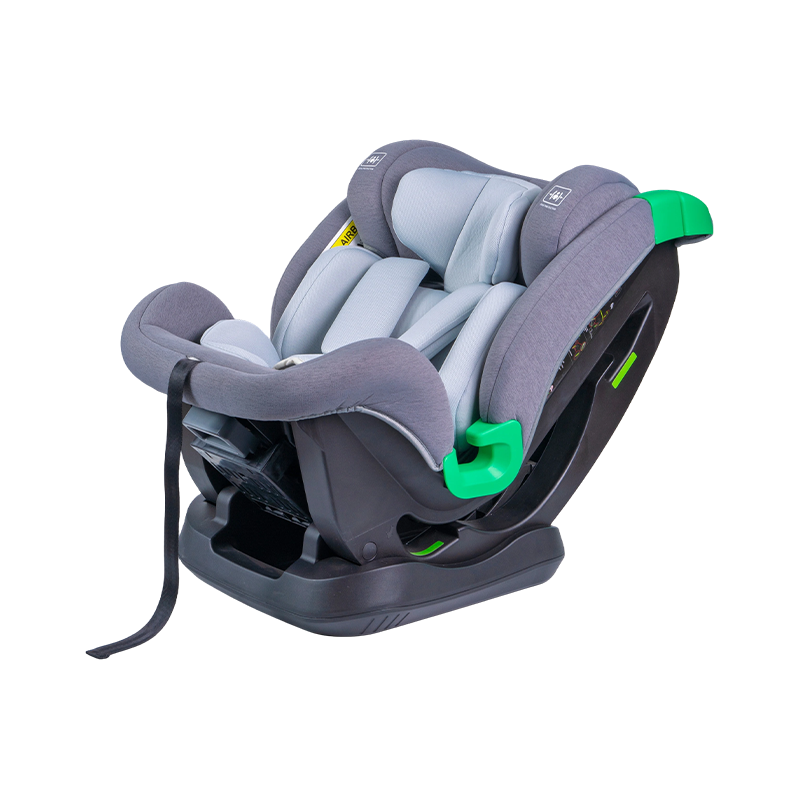 HB916Pro I-Size Belted baby car seat 40-105cmHB916Pro I-Size Belted baby car seat 40-105cm is a rear-facing car seat designed for newborns and toddlers, providing the highest level of protection for children who ...View Product →
If you want a deeper comparison of belt-routed seats, including how they behave in a crash and where installation errors usually creep in, our guide to belted baby car seats covers the details in more depth.
Older Children: The Danger Changes Shape
Once a child can sit up, hold their head reliably and is past their first birthday, the airway risk of a long spell in a seat drops sharply. The problems that remain are different but real: neck strain from a slumped head, numb legs, travel sickness, and the fact that an older child will rarely complain until things are unbearable.
- Boosters and high-back boosters recline very little, so plan a break every ninety minutes rather than every two hours.
- A high-back booster with a proper headrest gives a sleeping neck somewhere to rest instead of hanging forward.
- Window shades, water and a light snack reduce the misery of a long hot drive.
- Never leave a child alone in a car, at any age, for any period of time.
Rear-facing travel is still the strongest protection in a crash for as long as the seat allows, and an older child who protests about legroom is still far better protected than a forward-facing child of the same size. Comfort complaints are worth solving with a break and a stretch rather than by turning the seat around early.
How These Questions Shape What Gets Built and Tested
Parents often assume there is a test somewhere that covers sleeping in a seat. There is not. A car seat is approved through dynamic crash testing: a sled fires, the seat is measured, the dummy is checked. Nothing in ECE R44, ECE R129/i-Size or the Chinese GB and CCC requirements asks how a sleeping infant's airway behaves in hour three.
That leaves the sleep-related details to engineering judgement, and they show up in visible ways:
- How deep the recline positions actually go, and whether that angle can be held once the seat sits on a real vehicle bench.
- Where the harness slots and chest clip land on a sleeping child's shoulders, so the shell does not push the head forward.
- Whether a support leg or top tether stops the seat rotating and slowly losing its angle over a long drive.
- How thick the newborn insert is, and whether it can be removed cleanly as the child grows instead of leaving padding behind a small back.
We build child seats from a 40,000 square metre facility in Taixing, Jiangsu, with three assembly lines, more than ten blow-moulding and injection-moulding machines, and a seven-step flow that runs from fabric pattern-making and stitching through injection parts to final assembly and inspection. R44 and R129/i-Size product families sit side by side, with GB, CCC and ISO 9001 as the quality baseline. None of that changes the physics described above, but it does mean the angle a seat holds at three in the morning was a decision someone made deliberately rather than an accident of tooling.
Frequently Asked Questions
Can a baby sleep in a car seat overnight if the car keeps moving and an adult stays awake?
It is still not recommended. Even with supervision, eight hours in a semi-upright bucket is a long time for a small body: the neck stays flexed, the skin stays warm and damp, and the harness stays tight. Break the journey, take the baby out every two hours, and sleep somewhere flat when you stop.
Is it safer if my seat reclines almost flat?
A flatter recline reduces head slump and helps the airway, which is exactly why newborn seats use it. It does not turn the seat into a bed, because the baby is still in a harnessed shell that traps heat and limits movement. Check your manual for how far the recline can be used while the vehicle is moving.
My baby will only fall asleep in the car seat. What do I do at night?
That is a sleep association, and it is usually formed because the seat works so reliably. Rebuild the routine on the flat surface: dark room, consistent wind-down, white noise, and a patient two or three nights. The seat is a motion device. The cot is where sleep is supposed to happen.
How long can a newborn stay in a car seat in one go?
Thirty to forty-five minutes in a single stretch is a sensible ceiling for a newborn, with a break out of the seat before continuing. Two hours is the absolute maximum for any baby regardless of age, and health services treat it as a limit rather than a target.
Can my baby nap in the car seat inside the house?
Only if you are in the same room watching continuously, the seat is on the floor, and the nap is short. The moment you need to leave the room, unclip the harness and move the baby to a flat surface.
Do i-Size seats make overnight sleep safe?
No. The i-Size regulation controls crash performance, side-impact protection and height-based sizing. It says nothing about sleeping in a stationary seat. Rear-facing travel to at least 15 months and a correct installed recline do improve posture, which helps during a nap, but they do not change the overnight advice.
At what age does overnight sleep in a seat become acceptable?
There is no age at which a car seat becomes an approved sleep surface. The airway danger is greatest in the first year, but long seated spells are uncomfortable and unhealthy at any age. Older children are better off sleeping flat in a bed, even if that means an extra stop.
What about a night ferry or a long flight?
The principle travels with you. Devices designed to hold a child in a moving vehicle are not sleep surfaces. Take breaks, use an airline bassinet where one is available, and plan for flat sleep at the other end rather than assuming the seat will do the job overnight.
The next time a late-night drive tempts you to leave a sleeping baby strapped in until morning, do the maths on the alternative: one extra stop, one transfer to a flat mattress, one night of slightly broken sleep. That is the whole trade, and it is a straightforward one to make in advance rather than at 80 km/h in the dark.

For the safety of babies' travel, we are committed to being a reliable partner for babies and families, and to becoming an expert in children's car safety seats. This is our eternal pursuit.
Contact Us
For exclusive deals and latest offers, sign up by entering your email address below.
CONTACT INFORMATION
-
Address: North of Sitong Road and west of Lianfu Port, Hongqiao Industrial Park, Taixing City, Jiangsu Province
-
Phone: +86 15996087029
-
E-mail: [email protected]
Copyright © JIANGSU HAPPY BABY SAFETY SEAT CO., LTD. All Rights Reserved.
Wholesale Child Travel Safety Seat Factory