
 English
 中文简体
 Home / News / Industry News / Are 360 Rotating Car Seats Safe? Pros, Cons and What to Check Before Buying

Industry News
Are 360 Rotating Car Seats Safe? Pros, Cons and What to Check Before Buying
2026-11-13
Content
- 1 A 360 rotating car seat is safe when three things happen in order
- 2 What a 360 rotating car seat actually does
- 3 The safety case: why a 360 seat can be a good choice
- 4 What to check before buying a rotating car seat
- 5 Installation details that decide whether the seat is safe
- 6 How the seat fits different cars and families
- 7 Standards and build quality: what the label does and does not tell you
- 8 Product features that make a rotating seat easier to use correctly
- 9 Everyday checks that keep a 360 seat safe
- 10 Frequently asked questions
- 10.1 Are 360 rotating car seats as safe as fixed car seats?
- 10.2 Can a 360 seat be used from birth?
- 10.3 Is it safe to rotate the seat while the car is moving?
- 10.4 Does a support leg damage the car floor?
- 10.5 Are 360 seats too big for small cars?
- 10.6 Can I install a 360 seat with a seat belt?
- 10.7 What is the biggest installation mistake with a rotating seat?
- 10.8 How long should a child stay rear-facing in a 360 seat?
A 360 rotating car seat is safe when three things happen in order
A 360 rotating car seat is not automatically safer because it swivels. It is safe when the seat is approved for your child’s height, installed so the base cannot move, and locked in the travel position before the car moves. The rotation is a loading and access feature, not a crash-protection feature. The crash protection still comes from the shell, the harness, the rear-facing period, the side wings, the rebound control, and the way the seat is held by the vehicle.
The practical risk is simple: a rotating seat adds a mechanism, and a mechanism adds a step that must be checked. Parents who treat the swivel as a convenience and forget the lock are exposing a gap. Parents who treat the lock as part of the seat-belt routine get the access benefit without giving up the safety basics. That is the difference between a good 360 seat and a badly used 360 seat.
Locked travel position Must be confirmed every trip
The seat should click or indicate clearly when it is locked forward or rearward. If it still swivels by hand, it is not ready for travel.
Height approval Match the label, not the age
An i-Size seat is approved by height range. A 40-105 cm seat and a 76-150 cm seat are not interchangeable for a newborn.
Vehicle fit Check floor, seat shape, and belt path
A support leg needs a stable floor. A top tether needs an approved anchor. A seat belt installation needs a clear path without twists.
Before buying, ask one question: can I lock this seat with one hand while watching the child, without leaning over the seat? If the answer is no, the convenience is weaker than it looks. If the answer is yes, the 360 design can reduce back strain, make tightening the harness easier, and help you keep a child rear-facing longer because you do not have to twist your body at the kerb.
What a 360 rotating car seat actually does
A 360 rotating seat has a base and a seat body that turn relative to each other. Some models rotate only between rear-facing and forward-facing positions. Others rotate through a side-loading position so the child can be placed into the seat from the open door. The best designs separate “loading mode” from “travel mode” with a clear lock. A few allow rotation only when the seat is in a permitted position, which reduces the chance of driving with a half-turned seat.
The base may be held by a seat belt, ISOFIX connectors, a support leg, or a top tether. Those parts do different jobs. ISOFIX or the belt holds the base to the vehicle. The support leg limits forward rotation and pitching. A top tether limits forward movement in a different way and depends on an approved anchor point. One part does not replace another. A seat with ISOFIX but no support leg is not the same as a seat with both. A support leg is not a substitute for correct belt routing.
| Seat state | What it is for | What to check | Common failure |
|---|---|---|---|
| Rear-facing travel | Spreads crash forces across the back and head for as long as the seat allows. | Seat locked rearward; harness snug; support leg or tether set as required. | Seat left slightly turned after loading. |
| Forward-facing travel | Used only when the child has reached the seat’s approved height and the manual allows it. | Seat locked forward; belt path correct; top tether fitted if required. | Child moved forward too early because the seat can rotate. |
| Side-loading position | Lets the adult place the child in without reaching across the seat. | Door fully open; seat turned only while the vehicle is stationary. | Driving with the seat not fully locked. |
| Recline adjustment | Sets a suitable angle for a newborn or sleeping child. | Recline locked; no gap under the base; newborn insert used only as allowed. | Recline changed after installation and not rechecked. |
The rotation mechanism should feel firm, not loose. A small amount of play in a plastic trim part is normal; movement in the base or a seat that changes angle when pushed is not. If the seat rocks after installation, stop and redo the fit. Do not assume that a clicking sound means the installation is correct. Check the base at the belt path and at the ISOFIX connectors. Check the support leg indicator. Check the top tether tension if the seat uses one.
The safety case: why a 360 seat can be a good choice
The strongest safety argument for a rotating seat is not the swivel itself. It is the rear-facing time it can support. A seat that lets you load a child from the door makes it easier to keep the child rear-facing for longer, because you are not fighting the seat shell every morning. Rear-facing travel reduces the forward pull on the neck and spreads load over a larger part of the body. That is why height-based i-Size seats often keep children rear-facing well beyond the newborn stage.
The second argument is harness access. When the seat turns toward the door, the adult can see the harness, remove twists, and tighten the straps without leaning into the car. A snug harness is one of the most reliable day-to-day safety wins. A loose harness is a common misuse pattern, and misuse reduces the protection designed into the seat.
The third argument is vehicle fit. Some seats are hard to install in small cars because the door aperture is narrow. A rotating seat can make the child-loading phase easier, but it does not solve a bad fit. In fact, a rotating seat is often larger and heavier than a fixed seat. It needs more clearance behind the front seat and more space for the base. If the car is compact, the rotation may be blocked by the door or the front seatback. Check that first.
Real advantages
- Easier loading from the pavement side, especially with a toddler and a busy car park.
- Less reaching and twisting for the adult, which can improve harness tightening.
- Helps some families keep a child rear-facing for longer because the seat is easier to use.
- Useful when the child is asleep and the adult needs to avoid lifting across a fixed shell.
Real trade-offs
- Extra mechanism means an extra lock check on every trip.
- Higher weight and bulk can make moving the seat between cars less practical.
- Some models have limited recline in the rear-facing position.
- Support leg and top tether requirements vary, so the vehicle manual matters.
- Rotation can be blocked by a deep seat cushion, a high tunnel, or a front seatback.
Are 360 rotating car seats safe? Yes, when the seat is approved for the child, installed according to the manual, and locked for travel. No, when the lock is treated as optional or the seat is bought without checking the car. The safety question is not “does it rotate?” It is “does the lock work, does the base fit, and will I use the rear-facing position properly?”
What to check before buying a rotating car seat
Start with the label. A seat sold as i-Size should show an ECE R129 approval and a height range. A seat sold under R44 will use mass groups and a different approval logic. Do not mix the two systems in your head. If the label says 40-105 cm, the seat is intended for a small child and must be used rear-facing in that range. If it says 76-150 cm, it is not a newborn seat just because it rotates.
Next, check the lock. Sit in the driver’s seat and imagine the routine: open the door, turn the seat, place the child, fasten the harness, turn the seat back, listen for the click, push the seat to test the lock, then close the door. If any step requires two hands or a hard push, the design will be harder to use correctly in the rain or in a tight parking bay.
Approval and height range
Confirm the approval label, height range, and whether the seat is allowed in the front passenger seat. Never assume that rotation changes the airbag rules.
Travel lock
Look for a clear indicator, a firm click, and a lock that cannot be released by a child’s foot. The seat should not rotate while the car is moving.
Base support
Check whether the seat uses a support leg, a top tether, or both. Read the vehicle manual for floor storage compartments and approved anchor points.
Harness and inserts
The harness should tighten smoothly without twisting. Newborn inserts must be removed at the stated height or weight, not kept for comfort.
Side clearance
With the seat turned, can you still close the door? Does the seat hit the front seatback? Does the base overhang the vehicle seat?
Recline range
A newborn needs a suitable recline. An older child may need a more upright position. Check the adjustment range in the rear-facing mode you will actually use.
| Checkpoint | Pass condition | Why it matters |
|---|---|---|
| Vehicle floor under the support leg | Flat, stable, and approved for a support leg; no storage lid or soft trim. | A support leg needs a solid reaction point to limit forward rotation. |
| ISOFIX connectors | Both connectors engage with clear indicators; the base does not pull away from the seat bight. | A half-latched connector can let the base move in a crash. |
| Top tether anchor | Approved anchor, correct routing, and tension according to the manual. | The tether controls movement in a different direction from the support leg. |
| Seat belt path | Belt routed through the marked path, no twists, buckle clear of the frame. | A twisted or misrouted belt cannot hold the seat as designed. |
| Travel lock | Seat locked in the rear-facing or forward-facing position with a clear click. | A partly turned seat may not distribute crash loads through the intended structure. |
One more check is often missed: the space behind the front seat. A rear-facing 360 seat can take up more length than a fixed seat because the base and rotation ring add depth. If the front passenger needs legroom, test the seat in the car before you buy. A seat that fits the child but not the car is not a safe purchase.
Installation details that decide whether the seat is safe
A rotating seat can be installed with a seat belt or with ISOFIX. Belted installations are common in older cars and in seating positions without ISOFIX. The belt path must be followed exactly. The belt should not pass over the rotation ring, the harness adjuster, or a trim gap. If the seat has a lock-off, use it as the manual says. If the retractor does not lock, a locking clip may be required. Do not improvise.
ISOFIX installations are simpler in principle, but they still depend on the vehicle. The connectors must engage. The support leg must be set to the correct length. The indicator must show green or the equivalent. If the car has a floor storage compartment, check the vehicle manual before using a support leg. Some vehicles allow it; some do not. A top tether must go to an approved anchor, not to a luggage hook or a seat frame edge.
After installation, push the seat at the belt path and at the base. The base should not slide freely. A small amount of upholstery compression is normal. A base that lifts, rocks, or pulls away is not installed. Recheck the installation after a week, because the seat settles into the vehicle cushion. Recheck it after a child has climbed in and out several times. Recheck it after a long trip.
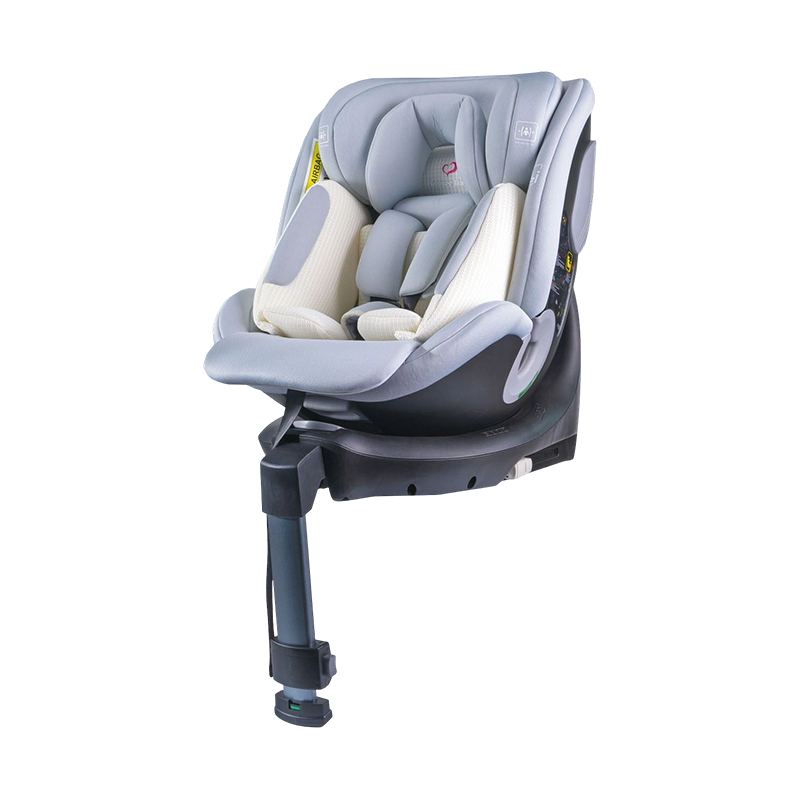
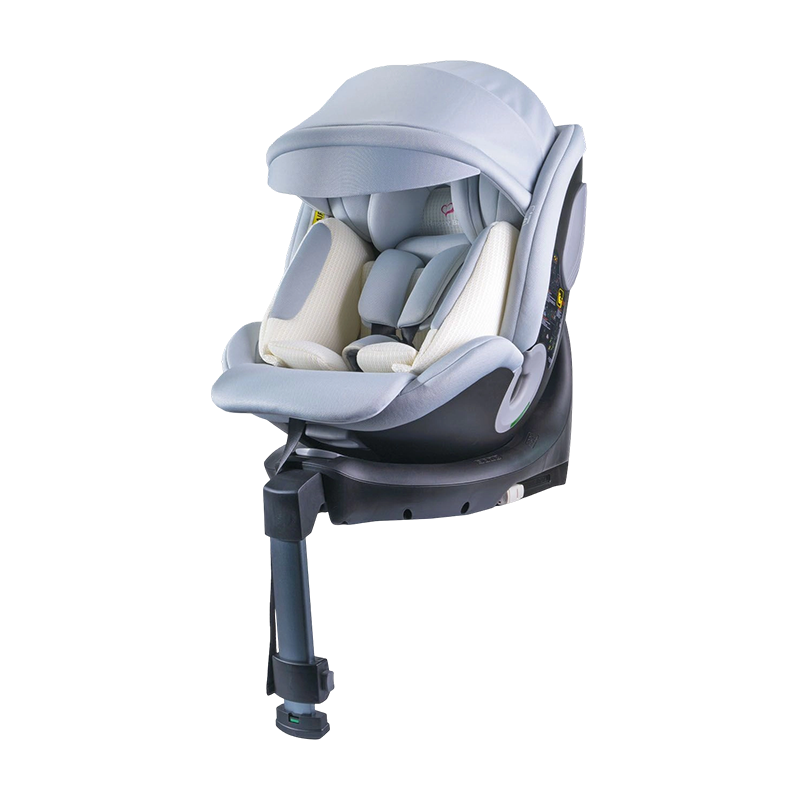 HB336 i-Size Rotating Car Seat with Support Legi-Size rotating seat with ISOFIX and telescopic support leg; covers 40–150 cm with four recline positions and six harness heights.View Product →
The support-leg detail is worth attention because it is easy to see but easy to misread. The leg should touch the floor with the indicator showing the correct load. It should not sit on a mat that compresses, a storage lid, or a loose object. If the leg is too short, the seat can pitch. If it is too long, the base can lift. Follow the numbered steps in the manual and check the leg again after you adjust the recline.
The bars are not crash-test results. They are a practical reminder of where parents and installers most often need to slow down. The highest-risk mistake is not a hidden defect. It is a normal routine step skipped because the seat is easy to turn.
How the seat fits different cars and families
A 360 seat is most useful in a car with a wide rear door opening and a flat rear floor. It is least useful in a compact car with a high tunnel, a deep seat cushion, or a front seatback that limits the rotation arc. If the seat cannot rotate fully without hitting the door or the front seat, the adult will be tempted to load the child from an awkward angle. That defeats the purpose.
Tight parking bays
A rotating seat lets the adult stand closer to the door and place the child from the side. It can reduce the need to open the door fully, but the seat still needs room to turn. Test the arc before buying.
Tall adults and long legs
A rear-facing 360 seat can take more front-to-back space. If the front passenger needs legroom, check the seat in the actual car with the front seat set for the usual passenger.
Second car or grandparent use
Heavy rotating seats are less convenient to move between cars. If the seat will be swapped often, check the weight and whether the base can stay in the car.
Newborn to toddler
A 40-150 cm rotating seat can cover a long range, but the newborn insert and rear-facing limits must be followed. Do not move to forward-facing because the seat can rotate.
Families often ask whether a rotating seat is worth it for a first child. The answer depends on the car and the adult’s back. If the car has a wide door and the seat locks firmly, it can make daily use easier. If the car is small and the seat is heavy, a fixed seat may be simpler and just as safe. The seat should fit the family routine, not the other way around.
For a second child, the rotation can be more useful because the adult may be loading two children at once. But the seat must still be checked every time. A rotating seat does not remove the need for a firm base, a snug harness, and a correct recline. It simply changes the loading angle.
Standards and build quality: what the label does and does not tell you
ECE R129 and ECE R44 are approval systems, not marketing badges. R129 uses height-based classification and includes side-impact criteria. R44 uses mass groups and has been the older system for many years. A seat can be legal under either system depending on the market and date. The important point is that the approval must match the seat’s stated use. A label on the base is not enough. The harness, inserts, and recline positions must match the manual for that approved configuration.
Build quality matters beyond the label. Look at the rotation ring, the lock mechanism, the harness guides, and the support leg. The plastic should feel rigid, not hollow. The lock should engage with a firm click. The harness should not rub on a sharp edge. The fabric should be removable for washing without exposing a loose foam insert. A seat built in a factory with controlled injection molding and assembly is more likely to hold consistent tolerances, but the buyer still needs to check the specific seat.
If you are comparing i-Size and older R44 seats, read the i-Size versus R44 safety differences before you decide. The approval system affects the height range, the installation rules, and the information the seat must provide. It does not make a badly installed seat safe.
 HB328 ISOFIX Top Tether 360 Rotation Car Seati-Size 40–150 cm seat with 360° rotation, ISOFIX plus top tether, side-impact protection and adjustable harness/headrest for multiple stages.View Product →
A top-tether 360 seat is a different installation case from a support-leg model. The tether controls forward movement, while the seat’s base and harness manage the child’s restraint. The tether anchor must be approved for child seat use. The strap must not rub on a parcel shelf or pass over a sharp trim edge. If the vehicle has no approved anchor, do not improvise one. Use a seat that matches the vehicle instead.
Product features that make a rotating seat easier to use correctly
The best rotating seat is not the one with the most features. It is the one whose features reduce misuse. A clear lock indicator is more valuable than a decorative trim. A harness that tightens without twisting is more valuable than an extra pocket. A support leg with a simple length adjustment is more valuable than a complicated recline lever that is hard to reach when the seat is rear-facing.
One-hand rotation
The seat should turn smoothly when the child is not in it and should lock with an audible click. The adult should not need to push the seat body against the door to make it turn.
Clear travel lock
A visible indicator or a firm click at both rear-facing and forward-facing positions helps confirm that the seat is ready for travel.
Support leg or top tether
The seat should make its installation method obvious. The required part should be included, not sold as an afterthought, and the manual should explain vehicle restrictions.
Height-based adjustment
The headrest and harness should move together. A seat that requires rethreading the harness at every stage is easier to misuse than one with a smooth height adjustment.
Newborn insert logic
The insert should be easy to remove at the correct stage. The manual should show the height or weight limit clearly, without vague wording.
Washable cover
A cover that removes without disturbing the harness or foam makes it more likely that the seat stays clean and the harness stays correctly routed.
 HB636 Group 0+/1/2/3 Rotating Car SeatECE R44/04 seat with 360° rotation, ISOFIX/top-tether or harness installation, and adjustable harness/headrest for birth to 36 kg.View Product →
A Group 1-2-3 rotating seat can be attractive because it covers several stages, but the parent must respect the stage limits. The seat may rotate and recline, but that does not mean the child should move to the next stage early. Use the height and weight limits, not the child’s birthday. If the shoulders are above the top harness slot, or the seat’s label says the child has outgrown the rear-facing mode, move to the next approved configuration. If the child still fits the rear-facing range, keep using it.
For buyers comparing the i-Size range, the R129 and i-Size seat range shows how height bands change the seat’s intended use. A 40-105 cm seat is not a small version of a 76-150 cm seat. They serve different stages. The rotation feature is useful in both, but the installation and recline rules are not the same.
Everyday checks that keep a 360 seat safe
Make the lock part of the same routine as the harness. Open the door. Turn the seat. Place the child. Fasten the harness. Tighten the harness. Turn the seat back. Listen for the click. Push the seat body to confirm the lock. Close the door. That sequence takes a few seconds, but it prevents the most common 360-seat mistake: driving with the seat not fully locked.
Check the harness height as the child grows. The harness should come from the correct slots for the rear-facing or forward-facing mode. Check the crotch pad and the buckle. A bulky coat or a thick blanket under the harness can create a loose fit. Remove bulky layers before tightening, or use a thin layer over the harness after it is tightened. The harness should pass the pinch test at the collarbone.
Check the support leg after every recline change. If the seat is moved from one car to another, recheck the base, the connectors, the tether, and the leg. Do not assume that the previous fit applies to the new car. Check the vehicle manual for floor storage compartments, underfloor spaces, and approved tether anchors. If the manual does not allow a support leg in that position, use a different seating position or a different seat.
Clean the seat without soaking the harness. Most harness straps should be wiped, not washed, because washing can remove flame retardants or weaken the webbing. Follow the seat manual. If the cover is machine washable, remove it carefully and photograph the harness routing before you take it apart. A seat that is reassembled with a twisted strap is less safe than a dirty seat.
Finally, inspect the rotation lock for wear. It should not feel loose or vague after months of use. If the seat rotates too easily when it should be locked, stop using it and contact the manufacturer or retailer. A lock that fails is not a convenience issue. It is a safety issue.
Frequently asked questions
Are 360 rotating car seats as safe as fixed car seats?
A correctly installed and correctly locked 360 seat can be as safe as a fixed seat. The approval standard, the installation, the harness fit, and the rear-facing period matter more than the rotation. The extra step is the lock. If the lock is not engaged, the seat is not in its approved travel configuration.
Can a 360 seat be used from birth?
Only if the seat is approved for newborn height and the recline and insert are set for a newborn. A 40-105 cm i-Size seat may be suitable, but a 76-150 cm seat is not a newborn seat. Check the label and the manual. Keep the child rear-facing for as long as the seat allows.
Is it safe to rotate the seat while the car is moving?
No. The seat should be rotated only when the vehicle is stationary. A rotating seat must be locked in the travel position before the car moves. Do not let a child play with the rotation release.
Does a support leg damage the car floor?
A correctly fitted support leg is designed to spread load through its foot. It can leave a mark on soft trim, so use the manufacturer’s mat if supplied. Do not place it on a storage lid, a loose mat, or a soft object. Check the vehicle manual for restrictions.
Are 360 seats too big for small cars?
Some are. A rotating seat needs space for the base and the rotation arc. Check the front-to-back space with the front seat set for the usual passenger. Check that the door can close and that the seat can turn without hitting the door or the front seatback.
Can I install a 360 seat with a seat belt?
Some models allow belted installation. Follow the belt path exactly, use lock-offs or a locking clip if required, and check that the belt is not twisted. If the seat is ISOFIX-only, do not try to belt it. The manual controls the allowed methods.
What is the biggest installation mistake with a rotating seat?
Driving with the seat not fully locked after loading. The second most common is a support leg that is not correctly set or is used on a floor area the vehicle does not allow. The third is a loose harness. All three are routine checks, not rare defects.
How long should a child stay rear-facing in a 360 seat?
Use the seat’s height limit, not a fixed age. If the seat allows rear-facing to 105 cm or 125 cm, keep the child rear-facing until that limit is reached. Move to forward-facing only when the manual permits it and the child has outgrown the rear-facing configuration.

For the safety of babies' travel, we are committed to being a reliable partner for babies and families, and to becoming an expert in children's car safety seats. This is our eternal pursuit.
Contact Us
For exclusive deals and latest offers, sign up by entering your email address below.
CONTACT INFORMATION
-
Address: North of Sitong Road and west of Lianfu Port, Hongqiao Industrial Park, Taixing City, Jiangsu Province
-
Phone: +86 15996087029
-
E-mail: [email protected]
Copyright © JIANGSU HAPPY BABY SAFETY SEAT CO., LTD. All Rights Reserved.
Wholesale Child Travel Safety Seat Factory